Withdrawal
Weight regain after tirzepatide withdrawal
After an initial reduction, SURMOUNT-4 separated continued treatment from withdrawal. The later measurements diverged.
After the lead-in
SURMOUNT-4 puts its decisive comparison after an initial success, a starting point I consider especially useful. The first reduction has already happened; the trial then asks what follows under different treatment assignments. That is an unusually useful sequel.
In SURMOUNT-4, 670 people were randomized after a 36-week open-label tirzepatide lead-in. Open-label means the treatment was known during that initial period. Mean weight reduction during the lead-in was 20.9%. The subsequent comparison separated continued tirzepatide from a switch to placebo.
From week 36 to week 88, mean weight change was −5.5% with continued tirzepatide and +14.0% with placebo. The continued-treatment group lost more weight; the group switched to placebo regained weight. These figures describe the period after the lead-in.
I consider that distinction central to the result. The initial success supplies the starting point for the later comparison, and the groups then move in opposite directions. A photograph at the end of the lead-in would miss the very question that makes this trial so useful.
The shared reference point is weight at week 36. The comparison is especially revealing because further loss and regain follow the different treatment assignments over the same later period.
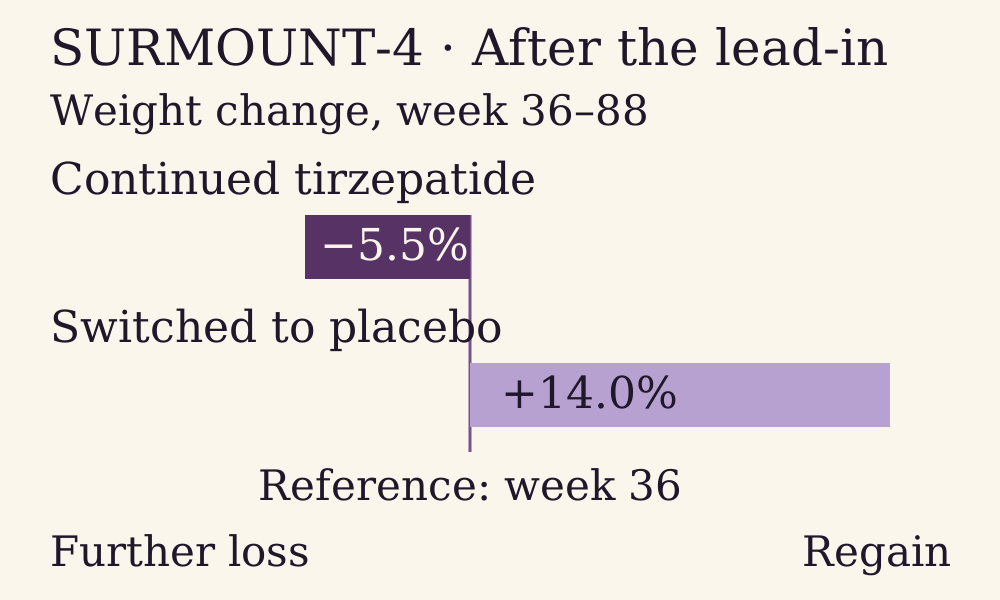
How much loss remained?
The same trial also reports weight reduction from week 0 to week 88: an overall mean reduction of 25.3% with continued tirzepatide versus 9.9% in the placebo group. The latter group had first received tirzepatide during the lead-in.
Another result expresses persistence in terms of the initial loss. In the continued-tirzepatide group, 89.5% maintained at least 80% of the lead-in weight loss, compared with 16.6% receiving placebo.
I find this a more interesting account than a simple verdict of success or failure after withdrawal. The placebo group regained substantial weight during the later period, while its mean weight at the final endpoint still reflected an overall reduction from the start. The earlier and later reference points answer different questions, and both matter.
This is where the idea of a self-contained transformation starts to feel inadequate to me. A substantial initial reduction leaves another phase to understand. The later comparison makes the conditions under which that reduction persisted much harder to ignore.
I began by thinking of withdrawal as an epilogue. In this trial, it feels more like the turning point. The initial reduction makes the later divergence possible to see; the switch to placebo makes it hard to leave the story at the earlier endpoint. The benefit observed during treatment and the regain after withdrawal both demand attention. Calling either one the whole story would leave out the result that makes the other more interesting. That is why the later phase now carries so much of the argument for me.
Risk markers after withdrawal
A post hoc SURMOUNT-4 analysis examined 308 people switched to placebo after tirzepatide. Greater regain tracked with worsening cardiometabolic parameters, including waist circumference, systolic blood pressure, non-HDL cholesterol, HbA1c and fasting insulin. Those with less regain showed less reversal.
That association raises the stakes of the weight sequel for me. It suggests that the later measurement has more to tell than whether a scale total rose. The analysis relates the amount of regained weight to changes in markers; the original randomized comparison examined the treatment assignments.
A clearer account of how these marker changes connect to later disease events would be especially valuable to me. The post hoc association already makes the follow-up question more consequential, while leaving that further question open. The cardiovascular-outcomes essay examines studies that asked about actual events or symptoms.
None of these group results supplies an individual stopping plan. The practical decision for a person requires a clinical conversation beyond this essay. My conclusion concerns the research: the later observation deserves as much seriousness as the initial reduction.